On the 26th of August, my friend Bernard and I boarded a plane in Yellowknife, Northwest Territories, and flew approximately 250 kms Northeast to a gravel airstrip north of MacKay Lake. We were to spend the next four days doing surveys for migratory birds in the area, both nocturnally, using radar, and diurnally, doing more typical birding. I should mention that we drove all the way to Yellowknife from Vancouver Island. A journey of just under 2400 kms, which took us about 48 hours. A truly LONG drive. Although we did our best to spot a few birds along the road, we were rushing the entire way, as we had to get our gear onto the plane the night before our departure. It really hurts to drive past so many great birding spots this time of year, without stopping.
The first thing I noticed upon stepping out of the plane and onto the gravel strip, was the lack of trees. We were now officially in the Arctic, being about 90 kms north of treeline, in what is known as the Barren Grounds region of the Northwest Territories. Not a tree to be seen. An odd feeling for a west coaster like me that has lived in the temperate rain forest virtually his entire life. The second thing I noticed, was that it was cold. Really damned cold! It was a balmy 18 degrees Celsius when we left Yellowknife, and now, only an hour later, it was a chilly 6 degrees, with an icy wind tearing at us out of the north. The third thing I noticed was a Common Raven nest built in the windsock tower along the airstrip. The only structure for miles more than about four feet tall, and it had a nest in it. Those tricky ravens!
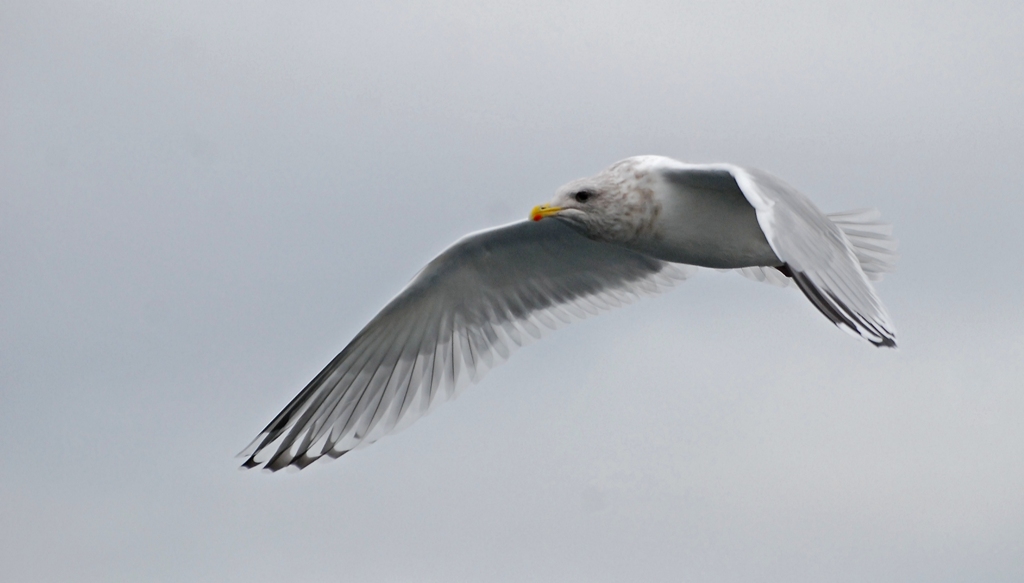
We pitched in and helped unload the airplane. About 4000 pounds of groceries, gas, various mechanical parts and pieces for the local mines, as well as our 750 pounds of sampling, camping, and tramping gear, was all quickly shuffled from the airplane, onto a goose neck trailer towed by a scabby looking old 4x4. Waiting to transport us to our staging camp, was a battered old tourist bus. We shook hands with the other passengers, most of them biologists or geologists on their way to the same camp as us, and set off down a dusty gravel road across the barren tundra. But it was anything but barren. Willows of several species grew everywhere, and at this time of year ran between various shades of green and yellow, to full on brilliant fall red. Dwarfed berry bushes of several species filled in between them, along with lichens, club mosses, grasses, and bare rock. And set all about us, were beautiful blue wetlands of various types and sizes. From huge deep lakes to shallow marshy pools, water was everywhere. As we drove, hundreds of passerines flushed along the road edges. Most appeared to be longspurs, but there were also sparrows, buntings, and pipits. In the wetlands I could see Red-breasted Mergansers, Long-tailed Ducks, Greater Scaup and various puddle ducks. Here and there a loon, at one site a Red-throated Loon, just around the corner a Yellow-billed Loon, and a couple of hundred meters up the road a lake with both Common Loons and Pacific Loons. All 4 species of Canadian loons in the space of about a kilometer! Herring Gulls, a few Horned Grebes, and the occasional small flock of Semipalmated Sandpipers rounded things out in the wetlands.
Upon reaching camp, we marched off the bus and straight into the cook shack for a camp orientation, as well as a great cup of coffee and all the baked sweets one could consume. The great butter tart massacre of 2011 was just getting underway. After getting settled into our rooms, which were located in an old meat locker, and only marginally cleaner than when cold beef swung in them, we had a few hours to kill before flying out to our nocturnal survey site. Bernard and I hiked along the road to the helicopter base, getting great views of Harris's Sparrow, Common Redpoll, and Yellow Warblers in the tiny grove a stunted spruce trees behind camp. The only trees for miles, and the warblers were there! Arctic Ground Squirrels ran along the tops of low mounds, and a Merlin of the beautiful taiga race, shot through the low scrub scattering Lapland and Smith's Longspurs, as well as American Pipits. A pair of Baird's Sandpipers called and flew off as the Merlin proceeded along the shore of a small lake where a Red-throated Loon was catching fish and then flying over into an even smaller lake, where it's well grown young were waiting. Despite the late date, we eventually saw all 4 species of North American loons feeding young in this area. By now it was time to start loading the helicopter for the flight out to where we would camp and perform bird surveys over the next four days, about 5 and a half kms northwest of camp. We also met Don, our Bear Monitor for the trip. A Bear Monitor is a person who guards other workers with a rifle, and a keen awareness of bear behavior, so that the workers can complete their tasks without having to look over their shoulders all of the time. Don was carrying a slick .270 rifle, and I instantly had the feeling that he knew exactly what he was doing. He had grown up on the land in this region back in the 1950's, and obviously knew how to deal with grizzlies, the only species of bear around here. We were too far north for Black Bears, and too far south for Polar Bears Don informed us. And actually, we had very little chance of ever even seeing a Grizzly. Barren Ground Caribou numbers were at an all time low, and bear numbers seemed to be way down as well. No one around camp could even remember the last time they had seen a bear nearby, and Don had great faith in us getting our work done without ever glimpsing a Grizzly. That suited us just fine. We had both had plenty of run-ins with bears in the past, and were just as happy to never see another one. So we loaded our gear into the helicopter, and flew off to set up our remote camp. The fun was just beginning! Or so we thought...